
Simon Squibb
BUSINESS ASSOCIATION
HelpBnk
Explore HelpBnk: company profileSimon Squibb is an entrepreneur, investor and author who founded HelpBnk and became widely known for street interviews asking people about the businesses and lives they want to build.
An early business shaped by necessity
Simon Squibb's official biography describes an abrupt start to working life. He says that his father died when he was fifteen and that he subsequently experienced homelessness. Gardening became his first business, supplying an immediate way to earn. Those circumstances are part of his own account of why entrepreneurship became important to him. They give context to his later interest in helping people start without an established network, substantial savings or a clearly mapped career.
A gardening business also makes the meaning of an initial customer unusually concrete. Someone has a task that needs doing, and another person offers to do it well enough to be paid. Squibb's later public teaching repeatedly returns to that practical starting point. His message draws attention to finding a useful first action, although the circumstances of one founder's early life should not be taken as a simple recipe for overcoming financial hardship.
Sources [1]
Building an agency career in Hong Kong
Squibb went on to build businesses and invest in other founders. His biography identifies Fluid, an agency in Hong Kong, as the business he sold to PwC. The sale is a central turning point in his public story: it separates an earlier period spent building a commercial operation from a later period devoted more visibly to education, investment and helping others develop their ideas. The account does not require an invented transaction value to explain that change.
Agency work differs from the spontaneous conversations for which he is now recognized. It involves clients, agreed work, creative delivery and the coordination of people responsible for a result. That background helps explain why his current public identity cannot be reduced to being an interviewer with an audience. His commentary about starting a business follows an operating career, even though a brief social-media clip rarely contains the detail needed to assess that experience fully.
Sources [1]
Making a direct question into a media format
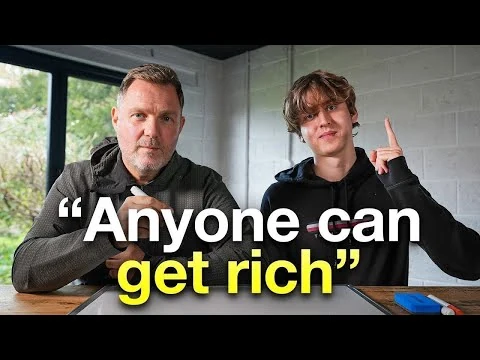
Squibb's most recognizable public format begins by asking someone about their dream. The question gives a short interview a clear purpose and invites a personal answer. Rather than starting with a finished company or a polished founder pitch, the conversation often concerns an ambition that has not yet become a practical plan. His official channels connect that format with a wider effort to encourage people to consider entrepreneurship and meaningful work.
A repeatable opening also makes the format easy to recognize across different people and settings. That is a media skill as well as a conversational one. The interviewer's question supplies continuity while the participant supplies a new story. For Squibb, those encounters connect his business background with an audience that may never attend an entrepreneurship event or read a conventional business publication. Visibility provides an opportunity to start a discussion, not evidence that every featured ambition becomes a sustainable company.
Founding HelpBnk around giving and receiving help
HelpBnk is the business most closely associated with this phase of Squibb's work. His official biography identifies him as its founder. The platform's public app page describes a place to ask for business help, exchange ideas and connect with other people. That offer turns a general encouragement to begin into a more specific attempt to connect someone facing a problem with another person who may be able to help solve it.
The distinction is useful when reading his public mission. An interview can give an ambition attention; a platform can provide a continuing place to seek advice or contribute experience. HelpBnk is therefore a separate operating project, even though Squibb's personal audience helps explain how people encounter it. Its value depends on what participants actually do for one another after joining, rather than simply on the reach of the founder's videos.
What a business-support community needs to do
HelpBnk's stated activities include finding support and connecting people who are building or willing to contribute. A request becomes more useful when it identifies a practical obstacle: explaining an offer, choosing a first marketing step or understanding how to approach a potential collaborator. A broad statement of ambition may start a conversation, but another person needs enough context to respond. This is the operational difference between inspiration and a useful exchange of help.
The same principle applies to the contributor. Relevant experience, a specific introduction or a considered answer can be more useful than a large volume of generic encouragement. This is an editorial reading of the community's purpose, rather than a claim that the platform guarantees the quality of every response. HelpBnk's own participation figures describe its stated reach; they do not independently establish how many lasting companies have resulted from using the service.
Sources [3]
Taking the question into a book
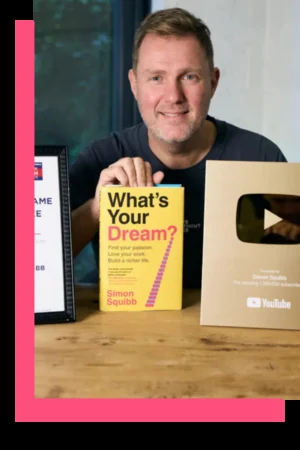
What's Your Dream? develops Squibb's central question in a longer format. His official book page describes material about identifying meaningful goals, addressing fear and beginning to turn an idea into a business. The book places a written structure around subjects that appear in his interviews. Someone can encounter the question in a short video and then explore the reasoning at a different pace, without expecting a single clip to provide an entire business education.
The book also helps distinguish Squibb's several activities. Publishing a book, running a business-support platform and investing in companies are related through his interests, but they are not the same service. A reader purchases an authored account; a community participant seeks an exchange; an investee has a particular commercial relationship. Keeping those distinctions visible makes his entrepreneurial work easier to understand than treating everything associated with his name as one undifferentiated personal brand.
Squibb describes helping ten million people start a business as a mission. The wording identifies an ambition for his work, rather than a completed result. It connects the public conversations, the book and HelpBnk through a shared interest in making an entrepreneurial idea easier for someone to act on.
The meaning of giving before a transaction
Squibb associates his public work with giving without expecting an immediate return. Within the context of business education, that idea asks people to recognize useful contributions outside a direct purchase. An introduction, a piece of knowledge or the time spent understanding another person's problem can create an opportunity that money alone would not resolve. HelpBnk gives that principle a place within the design of a community rather than leaving it only as a slogan.
There are still practical limits. A generous interaction is not automatically a business model, and a large audience does not remove the need to maintain a product and a useful participant experience. Those observations help clarify the work behind the public mission. The project must make it easier for appropriate people to find one another, while the founder's media activity continues introducing people to the broader idea of starting and contributing.
A public personality with an operating project
The career described in Squibb's own materials moves from necessity-driven work to agency building, then toward investment, publishing and a business-support network. His current prominence comes partly from the accessibility of his interviews. Someone does not need specialist knowledge to understand a question about a dream, which makes the format an effective entrance to topics that can otherwise feel remote or technical.
His place in this collection rests on the connection between that public identity and identifiable business activity. HelpBnk supplies a concrete company association, while Fluid provides important historical background. The book and interviews explain how he communicates with a wider audience. Together these elements show a founder using media to bring people toward a project built around business participation, without assuming that encouragement, platform membership and commercial success are interchangeable outcomes.
The evidence behind the account
Sources & further reading
The linked source material was checked on October 17, 2026. Company and creator descriptions are first-party accounts. Roles and business relationships may change. Source numbers refer to the sections above.
- simonsquibb.comWho Is Simon Squibb? | Author, Entrepreneur & Founder
- helpbnk.comHelpBnk
- mobile.helpbnk.comHelpBnk - Waitlist
- simonsquibb.comWhat’s Your Dream? | Simon Squibb
IN PICTURES THE PHOTO ARCHIVE
More of Simon Squibb.
8 photographs
A closer look, beyond the biography.




CONNECTED BY FIELD
Other people.
Shared territory.

Media & Marketing
Alex Cooper
Unwell
Alex Cooper expanded a recognizable interview show into Unwell, combining her work as a host with the responsibilities of building a platform for other creators.

Digital Business
Alex Hormozi
Acquisition.com
From gym ownership to investment and publishing, Alex Hormozi develops his business ideas around the practical work of serving customers and building operations.

Digital Business
Andrew Tate
The Real World · The War Room
Andrew Tate's sporting background and public identity connect with digital learning and networking products, including The Real World and The War Room.